
14 April 2025
 Arts and Health
Raising awareness about the effects of climate change is too often done through alarmist messages that fuel eco-anxiety rather than transform it. This project proposes a shift in perspective: to make people feel the climate instead of overwhelming them with warnings—through art, Inuit culture, and artificial intelligence (AI).
Using real scientific data on ice melt and permafrost thaw in Nunavik, collected over several decades, a piece of music is first co-created by an Inuk composer and a non-Indigenous composer. These two works, conceived as reflections of one another, come together to form a single musical composition.
With the support of AI, this sonic material is then transformed into an immersive visual artwork. Sounds, shapes, colours, and textures respond to one another to create a mixed aesthetic experience—musical and visual, Inuit and non-Indigenous—that invites young adults in Quebec to sense the changing North in a new way.
The project’s ambition is twofold: to spark positive emotions around an anxiety-provoking issue, and to support the emergence of eco-resilient behaviours rather than paralysis. Participants’ emotional responses will be analyzed to better understand how art, culture, and AI can jointly support mental health in a context of climate crisis.
The project is led by the AgeTeQ laboratory and the Research Chair in Creative Economy and Well-Being (CREAT), in collaboration with Inuit and non-Indigenous artists, and researchers in neuroscience, philosophy, geography, music, and AI at the Université de Montréal and its partners.
It is funded by IVADO, as part of its commitment to environmental emergencies and the responsible use of artificial intelligence.
EVENTS
7 May 2025 – 7 May 2025
Montréal
Arts and Health Culture in the regions
 Digital Creativity
 Discoverability
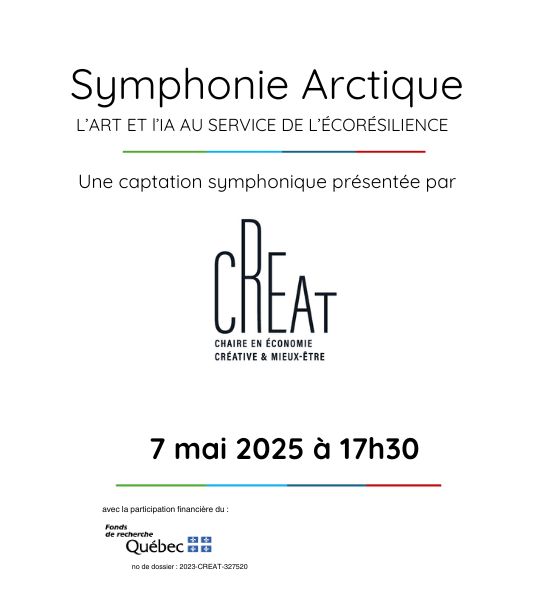
Invitation to “Symphonie arctique — L’art et l’IA au service de l’écorésilience”
Latest Podcasts & Videos
Regional Culture – Field Experiences
21 April 2026
Two cultural sector professionals working in regional areas, Mélanie Girard, Executive Director of the Musée du Bas-Saint-Laurent, and Éric Gagnon, Community Development Officer at Culture Côte-Nord, share their career paths and provide insight into on-the-ground realities.
Vulnerability, Resonance, and Our Connection to the Living World
13 April 2026
A conversation with Corine Pelluchon, philosopher and professor at Université Gustave Eiffel, exploring the relationship between vulnerability, aesthetic experience, ethics, and the transformation of our relationship to the world in the context of contemporary crises.
This discussion is part of an engaged philosophical perspective, rooted in the ethics of care, attentiveness, and resonance—as described by Hartmut Rosa—as well as in the human–nature connection.
Digital Creativity – Exploring New Artistic Forms
7 April 2026
How do practitioners integrate digital creativity into their work? Mélanie-Beby Robert, Director of Training Programs and Pedagogy at the École de cirque de Verdun, shares her experience.