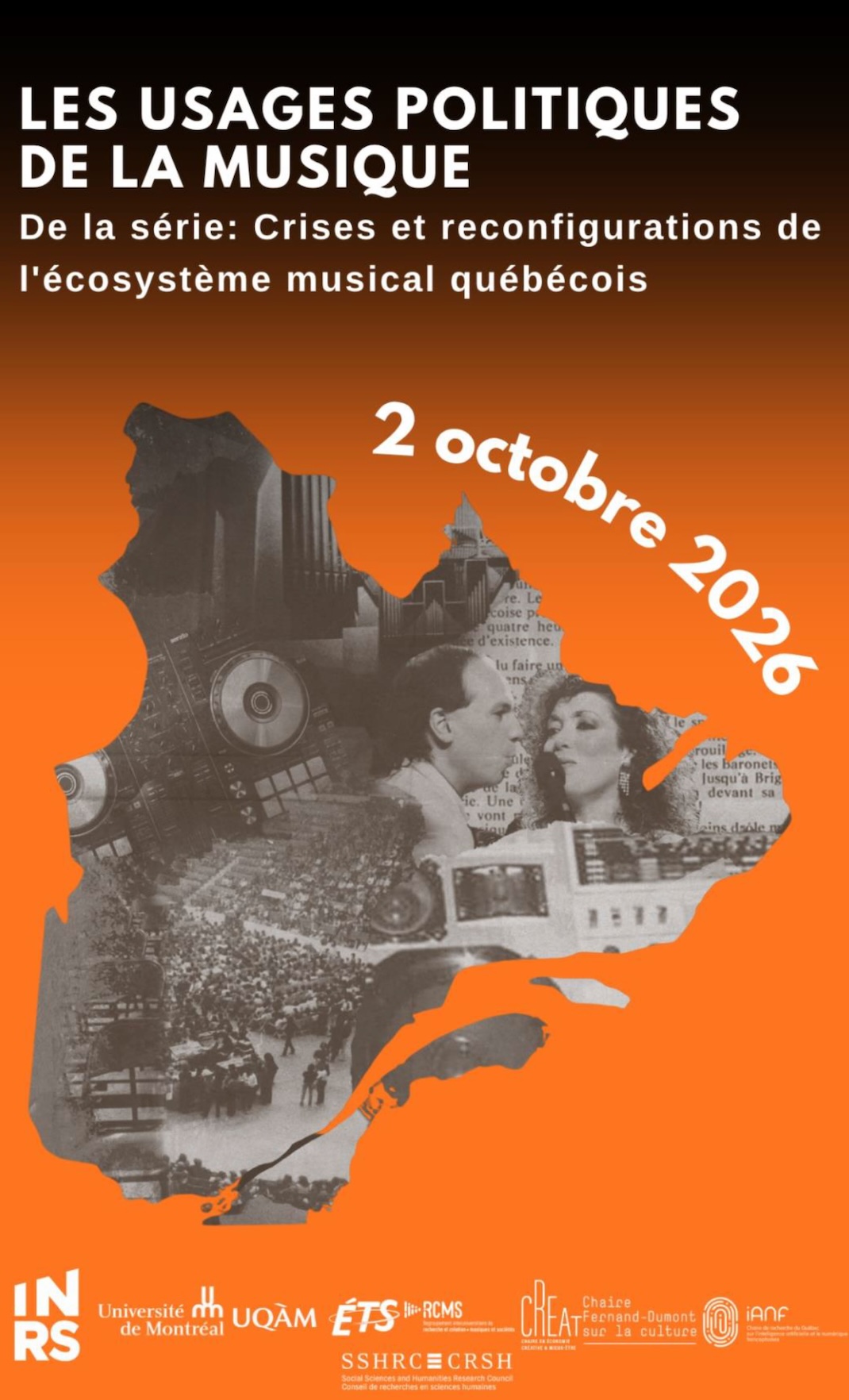

Study Day 2 > Les usages politiques de la musique
What does music do to politics, and politics to music? How does sound become, in turn, an instrument of mobilization, protest, or legitimation?
This second symposium will bring together researchers and members of the music community to explore the political uses of music, from cultural institutions to activist movements. Presentations will focus on the relationship between the cultural and political spheres during the Quiet Revolution; the sound practices that accompanied the 2001 Summit of the Americas; electronic music as an insurrectionary force; an assessment of the decade of mobilization for equity sparked by the open letter published in Le Devoir in 2017; and the political effects of community choral singing, drawing on the case of the RECAA Choir.
Program
9:00–10:00 a.m. — Entrée par effraction dans le champ culturel: la politique québécoise et la culture pendant la Révolution tranquille
With Jonathan Livernois (Université Laval)
10:00–11:00 a.m. — Mémoires sonores du Sommet des Amériques (Québec, 2001) : protocoles diplomatiques, créations musicales et spectacles militants
With Judith Hamel (Université de Montréal)
11:00–11:15 a.m. — Break
11:15 a.m.–12:15 p.m. — Du faire-rave au faire-grève : l’insurrection par le son ou la musique électronique comme révolution sonique
With Samuel Lamoureux (TÉLUQ)
12:15–2:00 p.m. — Lunch break
2:00–3:00 p.m. — Bilan critique d’une décennie de mobilisations pour l’équité en musique au Québec (2017-2026) : Vers une transformation durable de l’écosystème?
With Vanessa Blais-Tremblay (UQAM)
3:00–4:00 p.m. — Faire vivre et résonner ensemble la justice sociale : Potentialités et effectivités politiques d’une chorale de personnes âgées en action.
With Line Grenier (Université de Montréal)
4:00–4:30 p.m. — Break
4:30–5:15 p.m. — Grand témoin
Detailed Program
Register
Study Day News
—
This event is part of the Crises et transformations de l’écosystème musical québécois study-day series, taking place at several Montréal universities from September to December 2026, with support from the Social Sciences and Humanities Research Council of Canada’s (SSHRC) Connection Grants.