7 February 2024
 Arts and Health
Museums can help foster social inclusion and improve the overall health status of older adults. Paradoxically, many older people who complied with social distancing measures also suffered from the 2019 coronavirus pandemic, as this lockdown may have accelerated processes leading to physical frailty and increased risks to mental health.
This study aimed to examine whether a three-month cycle of weekly virtual visits to the Montreal Museum of Fine Arts (MMFA) could improve feelings of social inclusion, well-being and quality of life, and reduce physical frailty among community-dwelling older adults in Montreal.
A total of 106 older adults living in Montreal (Quebec, Canada) were recruited into a two-arm randomized clinical trial (intervention n=53 vs control n=53) conducted between January and April 2022. The intervention consisted of a 3-month cycle of weekly virtual MMFA visits. Social isolation, well-being, quality of life and frailty were assessed using validated scales administered on a web platform at baseline (M0) and after 3 months (M3) in the intervention group. The control group completed the same assessments on the same schedule. Outcomes were mean scores at M0 and M3, and changes in mean scores between M0 and M3.
The intervention group showed significant improvements in social isolation, well-being, quality of life and frailty scores compared with the control group, with the greatest benefits observed for frailty.
These results suggest that a three-month cycle of weekly virtual MMFA visits can improve social inclusion and the physical and mental health of community-dwelling older adults in Montreal.
Project registration | NCT05046288; Title: A 3-month Cycle of Weekly Montreal Museum of Fine Arts Tours to Promote Social Inclusion, Well-being, Quality of Life and Health in Older Community Members Experiencing Social Isolation; First posted date: September 8, 2021; prospectively registered; https://clinicaltrials.gov/ct2/show/NCT05046288
EVENTS
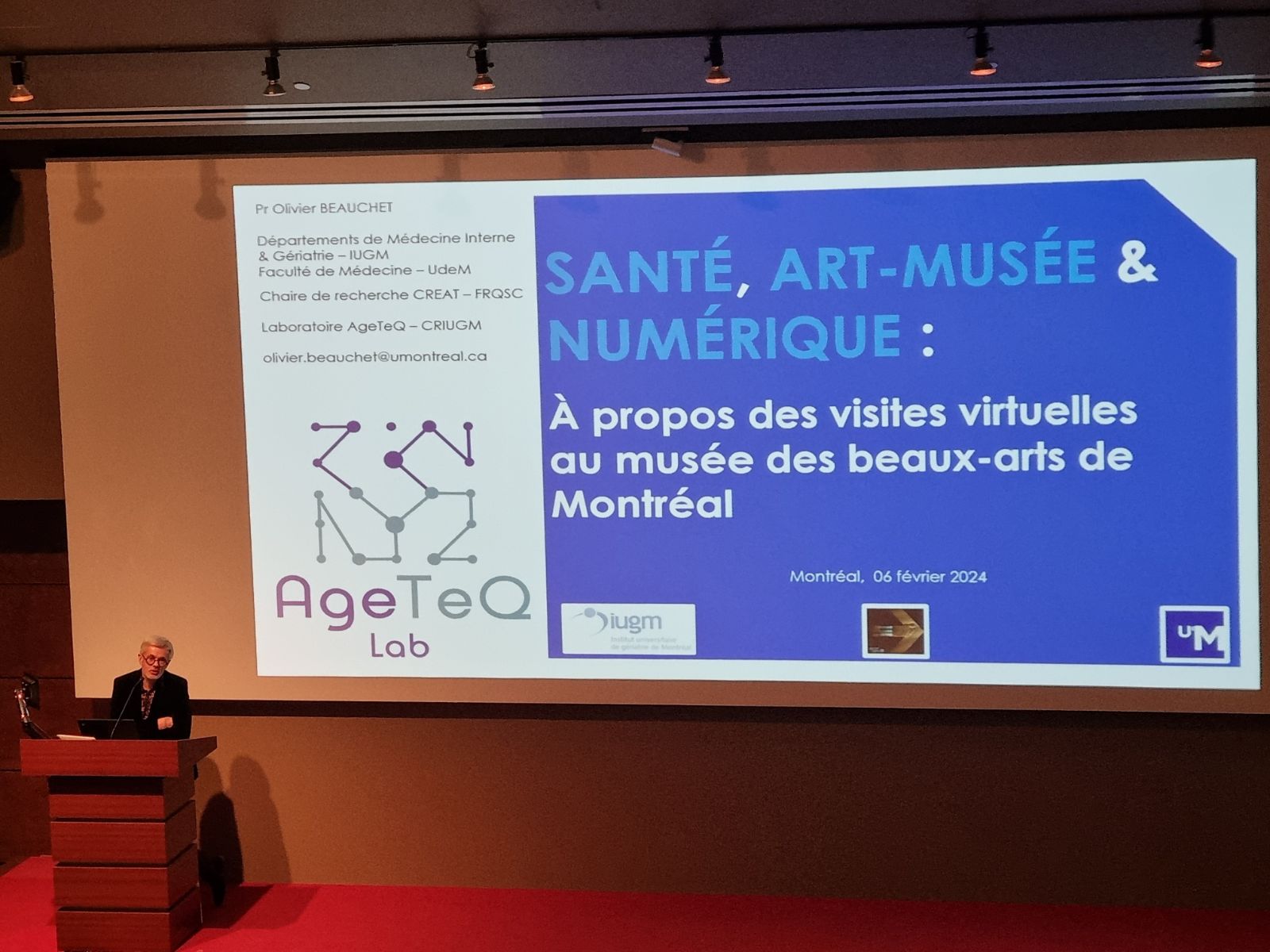
6 February 2024 – 6 February 2024
[ Free admission ]
Montréal
Arts and HealthPresentation of Results – Museum Visit Program
Latest Podcasts & Videos
Regional Culture – Field Experiences
21 April 2026
Two cultural sector professionals working in regional areas, Mélanie Girard, Executive Director of the Musée du Bas-Saint-Laurent, and Éric Gagnon, Community Development Officer at Culture Côte-Nord, share their career paths and provide insight into on-the-ground realities.
Vulnerability, Resonance, and Our Connection to the Living World
13 April 2026
A conversation with Corine Pelluchon, philosopher and professor at Université Gustave Eiffel, exploring the relationship between vulnerability, aesthetic experience, ethics, and the transformation of our relationship to the world in the context of contemporary crises.
This discussion is part of an engaged philosophical perspective, rooted in the ethics of care, attentiveness, and resonance—as described by Hartmut Rosa—as well as in the human–nature connection.
Digital Creativity – Exploring New Artistic Forms
7 April 2026
How do practitioners integrate digital creativity into their work? Mélanie-Beby Robert, Director of Training Programs and Pedagogy at the École de cirque de Verdun, shares her experience.