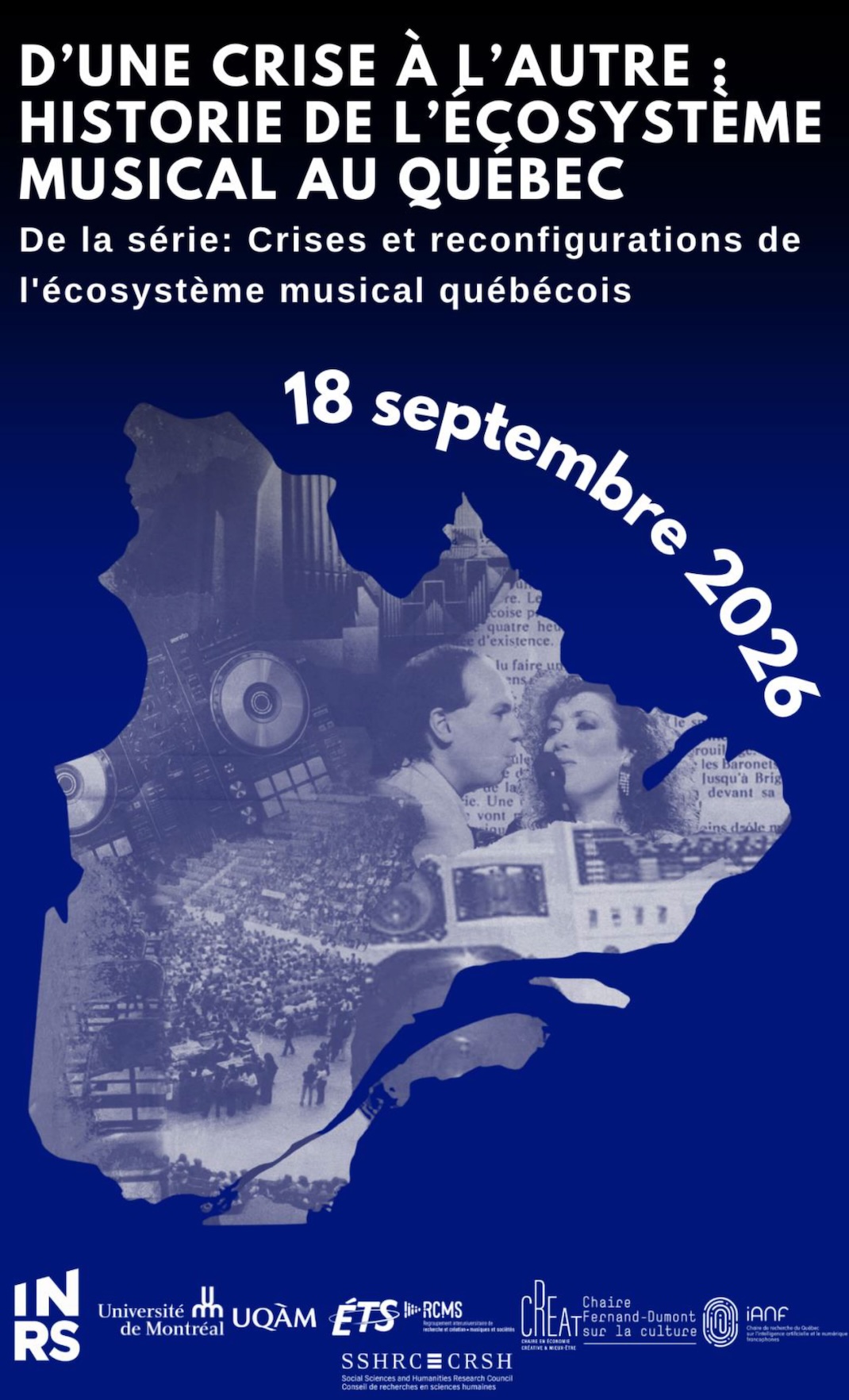

Study Day 1 > D’une crise à l’autre : histoire de l’écosystème musical au Québec
How has Québec’s music ecosystem developed over time? What technological, economic, media, and political changes have shaped its evolution?
This first study day will bring together researchers and members of the music community to examine several defining moments in this history. The presentations will explore the industrialization of music between 1860 and 1960, the expansion of the music industry in the late 1950s, the emergence of boîtes à chansons during the Quiet Revolution, and the development of Québec policies supporting classical and popular music.
Please note that this event and all presentations will be held in French.
Program
9:00–10:00 a.m. — Ouverture et introduction du cycle de journées d’étude
With Andréanne Rousseau (INRS and ÉTS), Romuald Jamet (INRS), and Guillaume Blum (ÉTS)
10:00–11:00 a.m. — Moments charnières de l’industrie musicale au Québec de 1860 à 1960
With Sandria P. Bouliane (Université Laval), Jean-Hugues Robert (Université Laval), and Francis Lapointe (UQAM)
11:00–11:15 a.m. — Break
11:15 a.m.–12:15 p.m. — 1957, tournant de la modernité musicale
With Richard Baillargeon (Radio CKIA)
12:15–2:00 p.m. — Lunch break
2:00–3:00 p.m. — L’émergence du mouvement des boîtes à chansons dans le contexte de la Révolution tranquille
With Anne-Marie Tézine (UQAM)
3:00–4:00 p.m. — Les politiques culturelles à l’égard de la musique classique et de la musique populaire au Québec : stratégies parallèles ou convergence identitaire?
With Fernand Harvey (INRS)
4:00–4:30 p.m. — Break
4:30–5:15 p.m. — Cocktail reception
Detailed Program
Register
Study Day News
—
This event is part of the Crises et transformations de l’écosystème musical québécois study-day series, taking place at several Montréal universities from September to December 2026, with support from the Social Sciences and Humanities Research Council of Canada’s (SSHRC) Connection Grants.