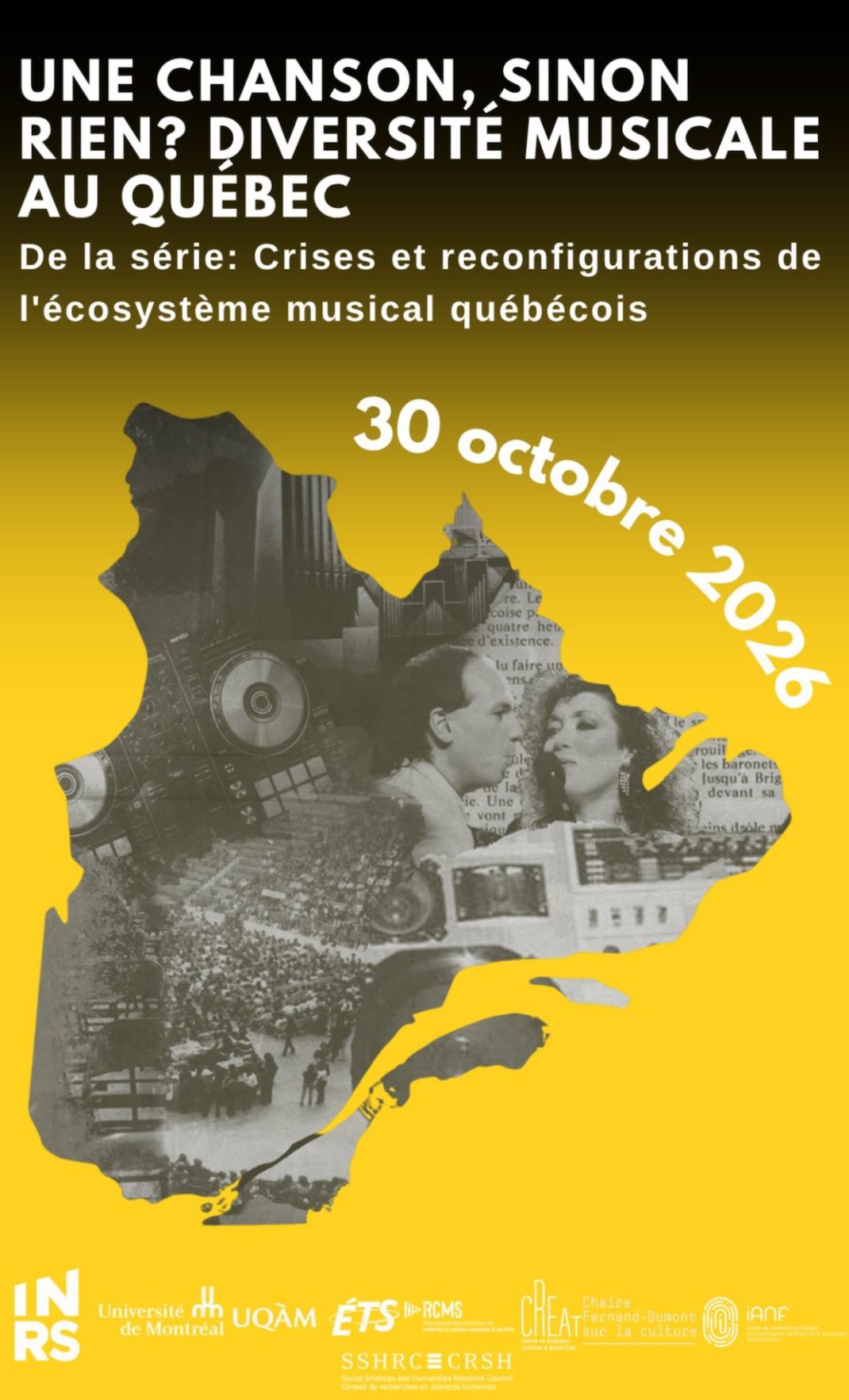
Study Day 4 > Une chanson, sinon rien ? Diversité musicale au Québec
Can song alone capture the full scope of Quebec music? Which voices, repertoires, and artistic trajectories remain in the blind spots of institutions and platforms?
This fourth study day will bring together researchers and music professionals to explore the diversity of musical expression in Quebec and the hierarchies that shape it. Presentations will examine women’s contributions to Quebec’s song heritage in the digital age; transculturalism across musical genres in the work of Robert Charlebois; the rise of Arab-Andalusian music as a scene emerging from recent immigration; the reception of film music through the lens of identity; and the reshaping of identity in Beatrice Deer’s creative work, between Nunavik and Montreal.
Program
9:00 – 10:00 a.m. – Où est le matrimoine de la chanson québécoise à l’ère du numérique ?
With Cécile Prévost-Thomas (Université Sorbonne Nouvelle)
10:00 – 11:00 a.m. – Repenser les genres musicaux au Québec : Robert Charlebois et le transculturalisme
With Benjamin Caron (Université Laval)
11:00 – 11:15 a.m. – Break
11:15 – 12:15 p.m. – Immigration et scènes musicales émergentes au Québec. Le cas de la musique arabo-andalouse (2015-2023)
With Caroline Marcoux-Gendron (UQAM)
12:15 – 2:00 p.m. – Lunch Break
2:00 – 3:00 p.m. – Réception identitaire de la musique de film au Québec : négocier les cultures locales et internationales
With Émilie Lesage (INRS)
3:00 – 4:00 p.m. – Reconfigurations identitaires et création musicale : le cas de Beatrice Deer
With Simon Labonté (Université de Montréal)
4:00–4:30 p.m. — Break
4:30–5:15 p.m. — Grand témoin
Detailed Program
Register
Study Day News
—
This event is part of the Crises et transformations de l’écosystème musical québécois study-day series, taking place at several Montréal universities from September to December 2026, with support from the Social Sciences and Humanities Research Council of Canada’s (SSHRC) Connection Grants.