
14 April 2025
 Arts and Health
Raising awareness about the effects of climate change is too often done through alarmist messages that fuel eco-anxiety rather than transform it. This project proposes a shift in perspective: to make people feel the climate instead of overwhelming them with warnings—through art, Inuit culture, and artificial intelligence (AI).
Using real scientific data on ice melt and permafrost thaw in Nunavik, collected over several decades, a piece of music is first co-created by an Inuk composer and a non-Indigenous composer. These two works, conceived as reflections of one another, come together to form a single musical composition.
With the support of AI, this sonic material is then transformed into an immersive visual artwork. Sounds, shapes, colours, and textures respond to one another to create a mixed aesthetic experience—musical and visual, Inuit and non-Indigenous—that invites young adults in Quebec to sense the changing North in a new way.
The project’s ambition is twofold: to spark positive emotions around an anxiety-provoking issue, and to support the emergence of eco-resilient behaviours rather than paralysis. Participants’ emotional responses will be analyzed to better understand how art, culture, and AI can jointly support mental health in a context of climate crisis.
The project is led by the AgeTeQ laboratory and the Research Chair in Creative Economy and Well-Being (CREAT), in collaboration with Inuit and non-Indigenous artists, and researchers in neuroscience, philosophy, geography, music, and AI at the Université de Montréal and its partners.
It is funded by IVADO, as part of its commitment to environmental emergencies and the responsible use of artificial intelligence.
EVENTS
7 May 2025 – 7 May 2025
Montréal
Arts and Health Culture in the regions
 Digital Creativity
 Discoverability
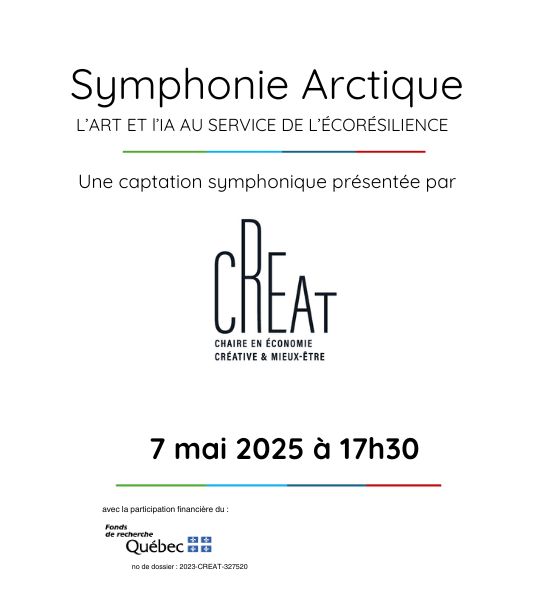
Invitation to “Symphonie arctique — L’art et l’IA au service de l’écorésilience”
Latest Podcasts & Videos
The Discoverability challenge led by cultural stakeholders
30 March 2026
How can the visibility of cultural works be enhanced in an increasingly saturated environment? Two key figures from Quebec’s cultural sector—Michel Vallée (President and CEO of Culture pour tous!) and Jean-Benoît Dumais (Executive Director of the Coopérative des librairies indépendantes du Québec – leslibraires.ca)—share their perspectives and initiatives.
Perspectives and the Future of the Creative Economy
23 March 2026
Students from CREAT share their perspectives and research. From regional culture to the arts and health, as well as digital creativity and discoverability, these intersecting viewpoints offer an inspiring glimpse into the future of the creative economy and its impact on collective well-being.
Understanding the challenges of discoverability to make music accessible
16 March 2026
At the intersection of migration trajectories and Québec’s cultural ecosystems, this episode explores the priorities that should guide efforts around discoverability. Caroline Marcoux-Gendron, Affiliated Professor at the Université du Québec à Montréal, and Romuald Jamet, Associate Professor at INRS, discuss the distinctive features of Québec’s music landscape: its linguistic, institutional, and cultural dynamics, as well as the recognition biases that affect, among others, artists from immigrant backgrounds.