
19 August 2024
 Arts and Health
This study aimed to develop a new intervention for patients hospitalized in a geriatric short-stay unit, with the goal of improving their well-being and quality of life. The intervention consisted of an art-therapy–type activity based on music and virtual reality (VR). Specifically, we examined the feasibility and effects on mental health—that is, positive affect, well-being, quality of life, and anxiety—of a 15-minute immersive intervention, delivered once a day for two consecutive days. The intervention consisted of watching and listening, through a VR headset, to musicians performing classical music in a concert hall, among patients hospitalized in the Unité de réadaptation fonctionnelle intensive ( (URFI) of the Institut Universitaire de Gériatrie de Montréal (IUGM).
The study design was a single-center, parallel-group randomized clinical trial comparing:
– an intervention group, in which participants watched and listened to a concert of musicians performing classical music through a VR headset;
– a control group, in which participants listened to the same concert using audio headphones only.
A total of 40 participants aged 60 years and older, hospitalized in the URFI at the IUGM, was recruited: 20 in the intervention group and 20 in the control group, over a six-month period.
The primary objective was to assess the feasibility of a 15-minute immersive intervention, delivered once a day for two consecutive days, consisting of watching and listening to classical musicians through a VR headset.
The secondary objective was to quantify and compare, between the intervention group (watching and listening to musicians with a VR headset) and the control group (listening to music with audio headphones), the changes in scale scores measuring emotions, well-being, quality of life, and anxiety.
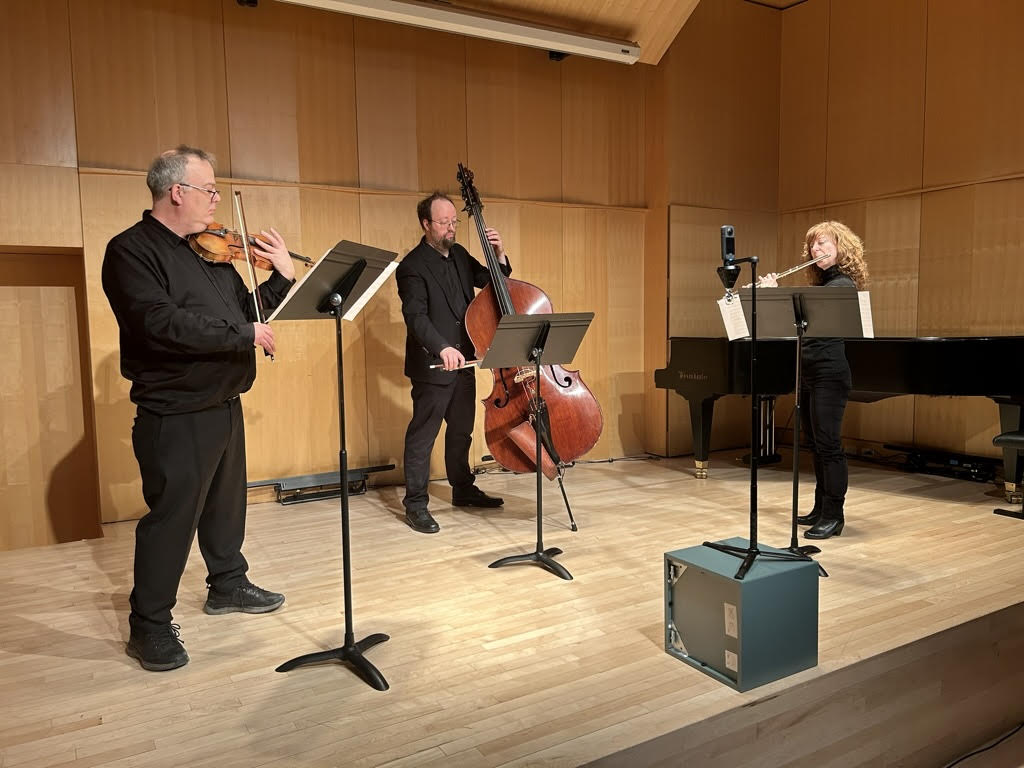
Credit | La Sams
News
Latest Podcasts & Videos
Perspectives and the Future of the Creative Economy
23 March 2026
Students from CREAT share their perspectives and research. From regional culture to the arts and health, as well as digital creativity and discoverability, these intersecting viewpoints offer an inspiring glimpse into the future of the creative economy and its impact on collective well-being.
Understanding the challenges of discoverability to make music accessible
16 March 2026
At the intersection of migration trajectories and Québec’s cultural ecosystems, this episode explores the priorities that should guide efforts around discoverability. Caroline Marcoux-Gendron, Affiliated Professor at the Université du Québec à Montréal, and Romuald Jamet, Associate Professor at INRS, discuss the distinctive features of Québec’s music landscape: its linguistic, institutional, and cultural dynamics, as well as the recognition biases that affect, among others, artists from immigrant backgrounds.
CREATivity in Action: Stories of Digital Practices
9 March 2026
Digital creativity is transforming the ways we produce and interact. Two researchers from CREAT—Philippe Vaucher, professor in the Unité d’enseignement et de recherche en création et nouveaux médias at the Université du Québec en Abitibi-Témiscamingue (UQAT), and Louis-Philippe Rondeau, also a professor at the École des arts numériques de l’animation et du design at the Université du Québec à Chicoutimi (NAD/UQAC)—shed light on current innovations in this field.