
16 January 2026
 Culture in the regions
Innovative entrepreneurship is developing across the entire territory of Quebec, but the issues faced by entrepreneurs in regional areas differ from those faced by entrepreneurs based in metropolitan centres. In fact, labour shortages are particularly acute in certain regions, and, more broadly, regions have more limited infrastructure and face greater distance from markets and suppliers. In this context, it can therefore be more difficult to attract and retain innovative entrepreneurs in Quebec’s regions.
This project addresses that challenge by pursuing the following objective: to understand how to respond to these issues and create an ecosystem that supports the attractiveness and retention of innovative entrepreneurs in regional areas.
To meet this research objective, we are proposing a methodological approach aligned with the principles of action research. Our approach is divided into three phases: the first consists of focus groups, the second of a self-administered survey, and the third of case studies. We will concentrate our research efforts in the regions where this project’s partner Business Accelerators and Incubators (BAE) are located: Bas-Saint-Laurent, Mauricie, Estrie, Outaouais, Côte-Nord, Gaspésie–Îles-de-la-Madeleine, Chaudière-Appalaches, Lanaudière, and Laurentides. In collaboration with the BAEs, we also identified five sectors with strong potential for innovative entrepreneurship in the regions under study: the technology sector, culture, agriculture, the social economy, and green technologies.
At the end of the project, we hope to create a regional BAE network that will remain active for several years. We are focusing on sharing best practices among regions, while emphasizing the specific characteristics unique to each one.
Given our action-research approach, the potential for uptake of the project’s outcomes in practice settings is very high. Project deliverables include an attractiveness strategy for the regions, a toolkit that will include podcast episodes and promotional materials, a report for the BAEs, and scientific articles. This unifying project brings together a team of nine BAEs from several regions of Quebec and seven professors from five Quebec universities. The project offers strong potential benefits for multiple regions, and enthusiasm among the BAEs remains strong, as the expected practical impacts are significant.
Attracting and retaining innovative entrepreneurs is relevant to several research projects proposed during the PERSÉIS program’s constellation meetings; inter-project collaborations are therefore encouraged. The project will run for three years, but the BAE network created will endure, and the BAEs will be able to take ownership of the project website to facilitate the sharing of best practices.
You can follow this PERSÉIS project’s video content on the project’s YouTube channel.

EVENTS
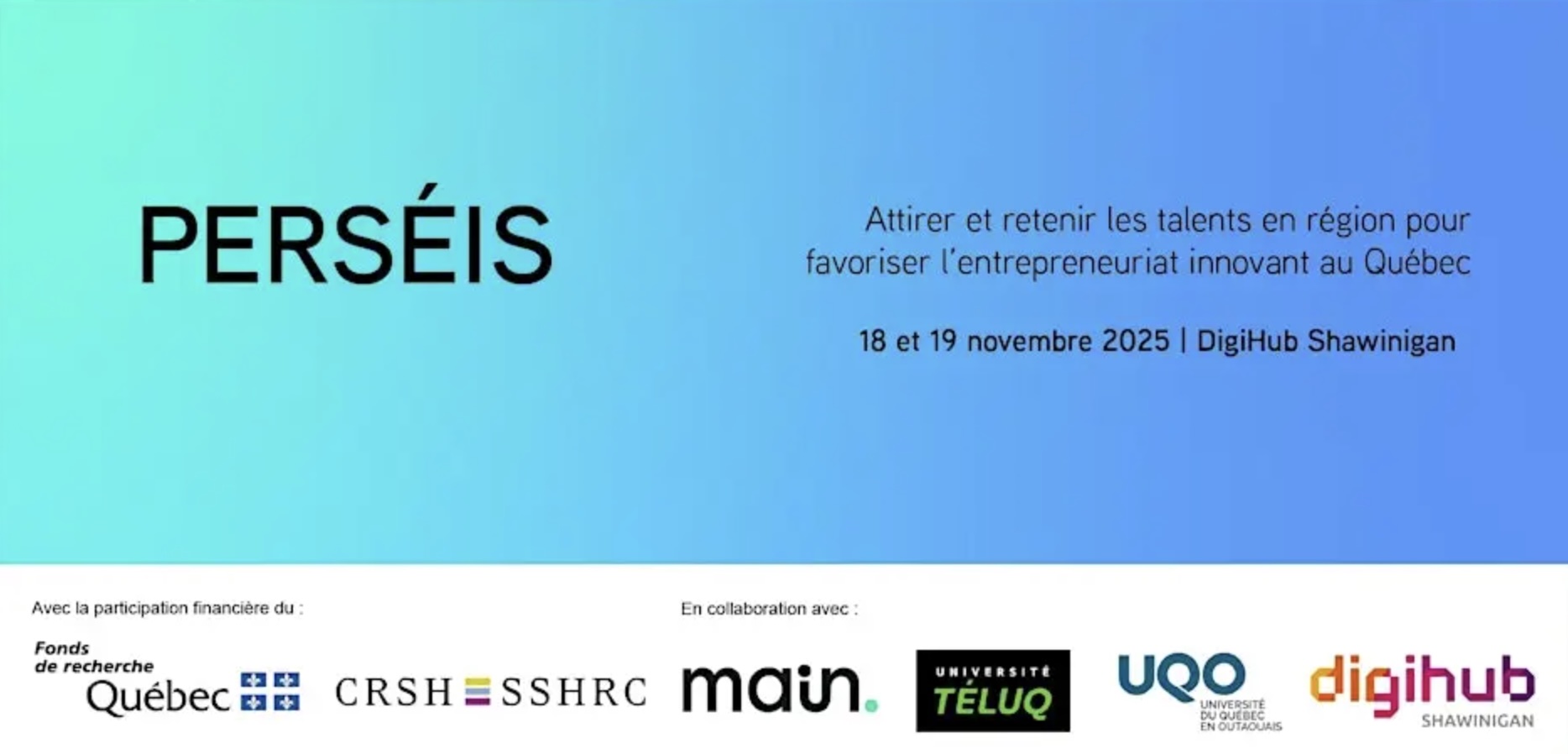
18 November 2025 – 19 November 2025
[ Upon registration ]
Mauricie
Culture in the regions