
11 November 2025
 Digital Creativity
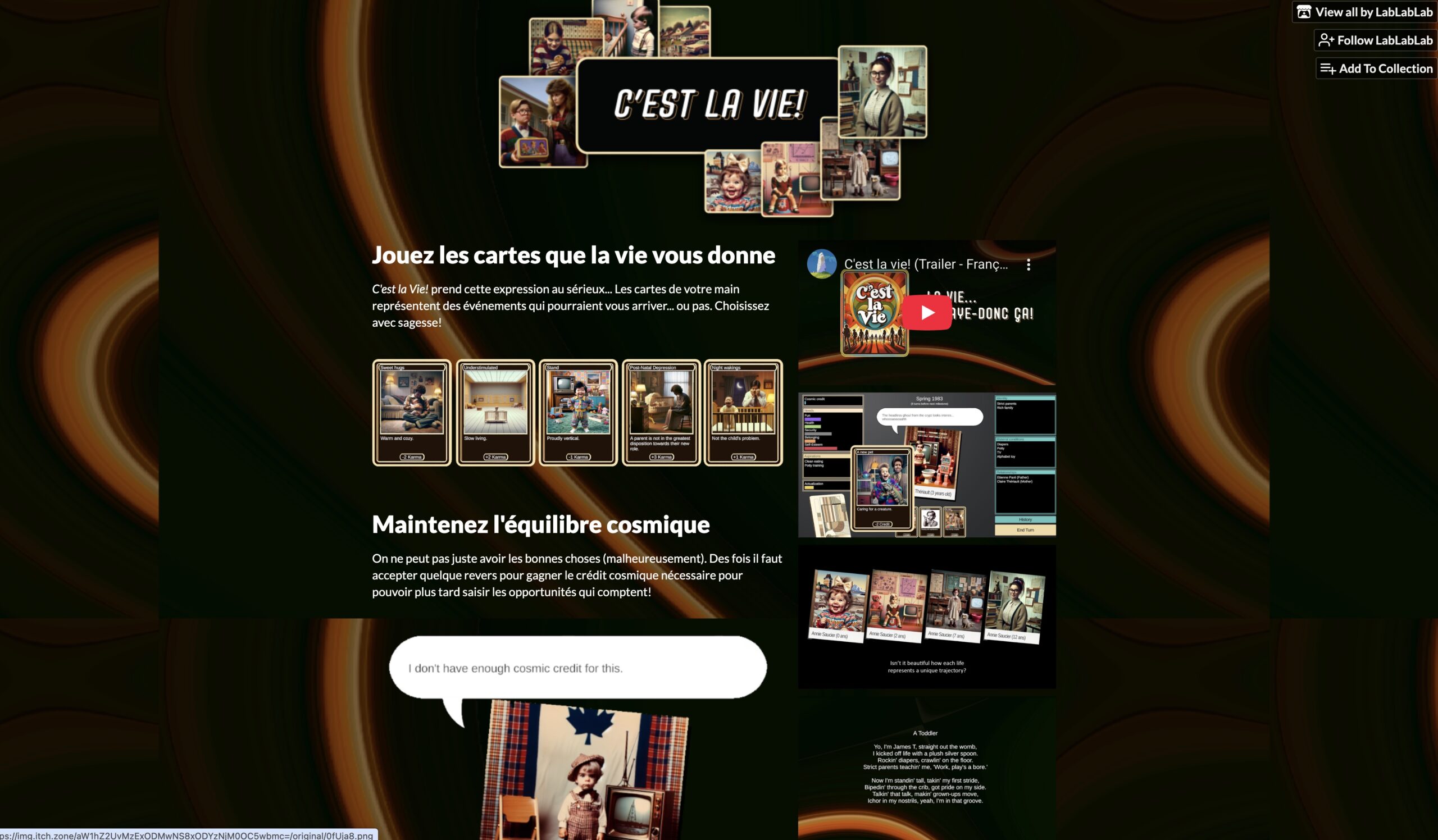
C’est la Vie! by Jonathan Lessard is an experimental video game artwork that explores the narrative and aesthetic possibilities offered by artificial intelligence within a creative framework. Designed as a sensitive and immersive interactive experience, the project combines game design, procedural writing, and locally generated imagery produced without relying on external services, ensuring ethical, technical, and energy control over the creative process. The online demo invites audiences to explore a hybrid universe where emerging technologies serve as a catalyst for artistic expression and reflection on new forms of digital storytelling.
Development, Dissemination, and Outcomes Overview
Project funding supported the formation of a student team composed of one PhD candidate, two master’s students, and two undergraduate students. Together, they worked on the production of the artwork, developing advanced skills in game design, narrative design, programming, version control methodologies, and the use of artificial intelligence tools, including the implementation of a fully local image-generation pipeline.
The online demo has been selected for several major events, including the International Conference on Games and Narrative 2024, Ludodrome 2025, and the art exhibition of the International Conference on Interactive Digital Storytelling 2025. The project was also presented during a discussion on innovation in video games at the Innovation in Video Games Summit.
While no scholarly publications have yet been produced, the project has generated research data on the development of specialized, localized, self-hosted, and energy-efficient AI models, as well as methodological reflections on integrating these technologies into video game creation.
This research project is funded by the Digital Creativity Axis and is part of the broader initiative on interdisciplinary collaboration within video game development teams.
Latest Podcasts & Videos
Perspectives and the Future of the Creative Economy
23 March 2026
Students from CREAT share their perspectives and research. From regional culture to the arts and health, as well as digital creativity and discoverability, these intersecting viewpoints offer an inspiring glimpse into the future of the creative economy and its impact on collective well-being.
Understanding the challenges of discoverability to make music accessible
16 March 2026
At the intersection of migration trajectories and Québec’s cultural ecosystems, this episode explores the priorities that should guide efforts around discoverability. Caroline Marcoux-Gendron, Affiliated Professor at the Université du Québec à Montréal, and Romuald Jamet, Associate Professor at INRS, discuss the distinctive features of Québec’s music landscape: its linguistic, institutional, and cultural dynamics, as well as the recognition biases that affect, among others, artists from immigrant backgrounds.
CREATivity in Action: Stories of Digital Practices
9 March 2026
Digital creativity is transforming the ways we produce and interact. Two researchers from CREAT—Philippe Vaucher, professor in the Unité d’enseignement et de recherche en création et nouveaux médias at the Université du Québec en Abitibi-Témiscamingue (UQAT), and Louis-Philippe Rondeau, also a professor at the École des arts numériques de l’animation et du design at the Université du Québec à Chicoutimi (NAD/UQAC)—shed light on current innovations in this field.